

A defensible contractor onboarding process clears a contractor to work only after five gates close: classification, a signed contract, verified safety and insurance documents, active payment details, and provisioned access. Get the sequence right and most of the admin happens online before the contractor ever reaches site, leaving only site-specific hazards for a short, one-page induction on arrival.
TL;DR:
- Proper classification must be completed and signed off before drafting any contracts to prevent costly misclassification issues later.
- Collect and verify all safety, licensing, and insurance documents prior to site access, setting reminder alerts for upcoming expiries to maintain compliance.
- Establish payment and tax details early, testing the payment method before work begins to avoid delays or trust erosion with contractors.
- Provision system or site access only after all documentation is verified and all compliance gates are closed, following the principle of least privilege.
- Conduct a concise, site-specific induction on arrival, focusing only on hazards unaddressed in prequalification, to streamline onboarding and promote early productivity.
Table of Contents
- What is the contractor onboarding process, step by step?
- How do you set up a contract before work begins?
- What documents do you need to verify before site access?
- How should you handle contractor payments and tax setup?
- How do you provision system and site access safely?
- What should a contractor's first day actually cover?
- When should you recheck contractor classification and documents?
- What are the most common contractor onboarding mistakes?
- What does a ready-to-use contractor onboarding checklist look like?
- How does safety prequalification fit into the onboarding workflow?
- Why fast onboarding and rigorous compliance aren't opposites
- Sources
- FAQ
What is the contractor onboarding process, step by step?
The contractor onboarding process starts with classification, not paperwork. Get the worker classification wrong and every document that follows, the contract, the tax forms, the insurance requirements, is built on the wrong foundation. That's why intake has to capture the right signals before anyone touches a template.
At intake, you're really answering one legal question: is this genuinely an independent contractor, or does the working relationship look more like employment? The test usually comes down to control, integration, and independence.
Your intake form should collect:
- Scope of work and whether it's a defined project or ongoing indefinite work
- Who controls how, when, and where the work gets done
- Whether the contractor works exclusively for you or serves other clients
- Expected duration and whether there's a genuine end date
- Whether the contractor supplies their own tools, insurance, and equipment
A compliance officer or HR manager should sign off on classification before the file moves anywhere else, because classification drives which contract and tax forms apply downstream. Skip this step or rush it, and you risk a misclassification claim months later, which costs far more to fix than it does to check properly upfront.
How do you set up a contract before work begins?
Once classification is confirmed, the contract is next, and it needs a signature before the contractor does anything billable. This is the second compliance gate, and it's where a lot of onboarding stalls happen because someone starts working off a verbal agreement while legal finalises the paperwork.
A workable contractor agreement or statement of work should spell out:
- Scope, deliverables, and acceptance criteria in plain language
- Payment terms, including rate, currency, and invoicing cadence
- Duration and termination conditions
- Confidentiality and data handling obligations
- Intellectual property ownership for anything created during the engagement
Use e-signature tools and version-controlled templates rather than emailing Word documents back and forth. A locked template library means legal reviews one master version, not fourteen slightly different copies floating around inboxes. NDAs and data processing clauses aren't optional extras for anyone touching client data, financial systems, or proprietary designs. If the contractor will see commercially sensitive material, build those clauses into the base template rather than bolting them on later.
Pro Tip: Keep two contract templates on file, one for project-based SOWs and one for ongoing retainer arrangements, so nobody drafts from scratch under time pressure.
What documents do you need to verify before site access?
This is where onboarding gets safety-critical, and where most organisations either move too slowly or skip steps they shouldn't. Documentation and prequalification exist to answer one question: can this contractor actually do the work safely and legally?
The document set breaks into two categories. First, identity and legal standing:
- Government-issued photo ID
- Business registration or ABN/NZBN equivalent
- Public liability and professional indemnity insurance certificates, current and not lapsing mid-engagement
- Trade licences or certifications relevant to the work
- Training records for equipment or processes specific to the job
Second, safety capability, which matters most for anyone stepping onto a physical site. Prequalification assesses a contractor's WHS management systems, insurance currency, licensing, incident history, and past performance, and it should happen before engagement, not on the morning they arrive. That means reviewing their Safe Work Method Statements, checking incident history, and where relevant, contacting referees from recent jobs.
Set conditional approvals for contractors whose documents are close but not quite complete, an insurance certificate expiring in three weeks, for instance, and automate expiry reminders 30 and 60 days out. A contractor cleared today but uninsured in six weeks is a liability nobody caught in time. Prequalification also demonstrates the reasonable due diligence steps referenced in WHS frameworks, which matters if you're ever asked to show your process held up.

How should you handle contractor payments and tax setup?
Payment friction is one of the most common reasons a contractor's first invoice sits unpaid for weeks, and it's almost always because banking or tax details weren't confirmed before work started. Fix this before the classification and contract gates close, not after.
For domestic contractors, collect:
- Tax file details and GST registration status if applicable
- Bank account details, verified against the name on the contract
- Agreed invoice frequency and payment terms (7, 14, or 30 days)
- Currency and any foreign exchange handling if the contractor is based overseas
- Who in finance approves invoices and at what value threshold
Foreign contractors add a layer, withholding tax obligations differ by country, and GST treatment on cross-border services isn't always straightforward. Confirm this with your accountant rather than guessing from a template built for local contractors. Before the first task is assigned, actually test the payment method works, a bounced first payment because of a typo in a BSB or account number erodes trust fast, and it's a completely avoidable mistake.
How do you provision system and site access safely?
Access provisioning should follow the same logic as everything else in the contractor onboarding process: give the minimum required, and tie every grant to the compliance gate closing first. A contractor who hasn't signed the contract has no business holding a login.
Apply least privilege as the default, not the exception. That means:
- Scoped system logins tied to specific tools, not blanket admin access
- Site access badges or PPE issued only after documentation and insurance clear
- Shared drive or project folder permissions limited to the current engagement
- Physical access (keys, swipe cards) logged with an expiry date matching the contract end
Automate the handoff between HR, IT, and facilities so provisioning triggers the moment the compliance gate closes, rather than relying on someone remembering to email IT. This is also where orphaned accounts creep in, contractors whose engagement ended months ago but whose system access never got revoked. Set a calendar trigger tied to the contract end date that forces a review, and audit active contractor accounts quarterly rather than assuming offboarding always happens cleanly.
What should a contractor's first day actually cover?
Once every gate is closed, the kickoff should be short, specific, and focused on getting the contractor productive fast, not repeating information they already know. This is where the online preboarding pays off, because a contractor who has already completed general safety modules, signed their contract, and had documents verified doesn't need a half-day induction session.
- Confirm the direct contact and reporting line for day-to-day questions
- Walk through the first deliverable and its deadline
- Cover only site-specific hazards, equipment, or access points not addressed in general prequalification
- Set a two-week check-in to review early output and flag any gaps early
Recognising a contractor's existing qualifications and general induction training means the on-site document only needs to cover what's actually unique to your site, which is what keeps it to a single page. Assigning a buddy or onboarding owner for the first few weeks improves integration and gives the contractor someone specific to flag issues to instead of guessing who to ask.
Pro Tip: Draft the one-page site induction once per site, not once per contractor, and update it only when the hazards on that site actually change.
When should you recheck contractor classification and documents?
Onboarding isn't a one-time event. Classification, insurance, and licensing all have a shelf life, and a contractor who was correctly classified in March can drift into employee territory by September if the scope of work quietly expanded.
Build a review cadence around these triggers:
- Recheck classification every six to twelve months, or immediately if scope, hours, or exclusivity change materially
- Centralise every document, contract, and approval in one system with timestamps, not scattered across email threads and shared drives
- Keep an audit trail showing who signed off on classification, contract approval, and document verification, and when
- Watch for signals a contractor should convert to employee status: fixed hours, exclusive engagement, integration into your management structure, or use of your equipment and premises
Atlas HXM recommends treating reclassification checks as routine rather than a one-off exercise, because the working relationship you signed off on paper rarely stays static once the engagement runs long enough.
What are the most common contractor onboarding mistakes?
Most onboarding failures aren't dramatic, they're small sequencing errors that compound. Here's what shows up most often, and the fix for each.
- Misclassification caught late: treat classification as a hard gate before any contract is drafted, not a formality reviewed afterwards.
- Missing or expired documents discovered on-site: verify insurance and licences digitally before the visit, never at the front gate.
- Slow handoffs between HR, legal, and finance: centralise documents and automate notifications so no file sits waiting in someone's inbox.
- Manual tracking that breaks at scale: spreadsheet-based tracking tends to hold up until roughly 20 to 50 active contractors, after which the administrative load starts creating real compliance exposure.
- No clear owner for each gate: assign one accountable person per gate, classification, contract, documents, access, so nothing falls through a handoff.
Pro Tip: If a contractor's role starts looking like an employment relationship, or a document dispute involves real legal exposure, escalate to legal, payroll, or a safety specialist immediately rather than trying to resolve it informally.
What does a ready-to-use contractor onboarding checklist look like?
A gate-driven checklist keeps the sequence honest and stops teams from skipping ahead because a deadline is looming. The order matters as much as the content.
- Classification confirmed and signed off by HR or compliance
- Contract or SOW drafted from template, e-signed by both parties
- Tax and payment details collected and bank account verified
- Documents (ID, licences, training records) uploaded and checked
- Insurance certificates verified as current, with expiry reminders set
- Access provisioned on least-privilege basis, tied to gate five closing
- Kickoff scheduled, with site-specific induction ready if applicable
Your intake form should capture, at minimum: contractor name and business details, scope of work, control indicators, duration, insurance status, and required licences. An SOW template should always include scope, deliverables, payment terms, duration, and IP/confidentiality clauses as standing sections.
| Gate | What "clear" looks like | Typical turnaround |
|---|---|---|
| Classification | Signed off by HR or compliance | Same day |
| Contract/SOW | E-signed by both parties | 1–2 days |
| Documents & insurance | Verified, no expiries within 30 days | 1–3 days |
| Access & kickoff | Provisioned and site induction ready | Hours once prior gates close |
Set expiry reminders at 60 and 30 days for every licence and insurance certificate, and review the whole checklist template annually against current WHS guidance so it doesn't quietly go stale.
How does safety prequalification fit into the onboarding workflow?
Prequalification and site induction solve two different problems, and conflating them is where a lot of onboarding processes waste time. Prequalification checks whether a contractor's business is generally safe to engage, its WHS systems, insurance, licensing, and incident history. Site induction checks whether that contractor understands the hazards of this specific location on this specific day.
Safety-engineering builds contractor onboarding around that distinction. A specialist reviews machinery interfaces, run-checks, and safety documentation as part of prequalification, well before a contractor sets foot on site, then issues a genuinely concise, site-specific induction covering only what's unique to that location.
- Prequalification confirms WHS management systems, insurance, and licensing at the business level
- Machinery and equipment checks validate safe interaction with plant specific to the site
- The one-page induction covers only local hazards, exclusions, and emergency procedures
- Recognising qualifications already verified in prequalification stops duplicated induction content
A one-page site induction that references only site-specific hazards removes duplication while keeping compliance clear, and it's the difference between a contractor spending their first hour reading generic safety slides versus actually starting productive work.
Explore how Safety-engineering structures machinery safety audits and site-specific training for businesses that need prequalification done properly the first time.
Why fast onboarding and rigorous compliance aren't opposites
Most organisations treat speed and compliance as a trade-off, slow down to be safe, or move fast and accept some risk. That's the wrong framing, and it's the biggest thing conventional onboarding advice gets backwards.
Speed comes from sequencing, not from skipping steps. A contractor onboarding process that puts classification first, automates document verification, and pushes the bulk of admin online before the site visit isn't cutting corners, it's removing the friction that makes onboarding feel slow in the first place. The organisations still stuck on paper checklists and email chains aren't more thorough, they're just slower at the same work.
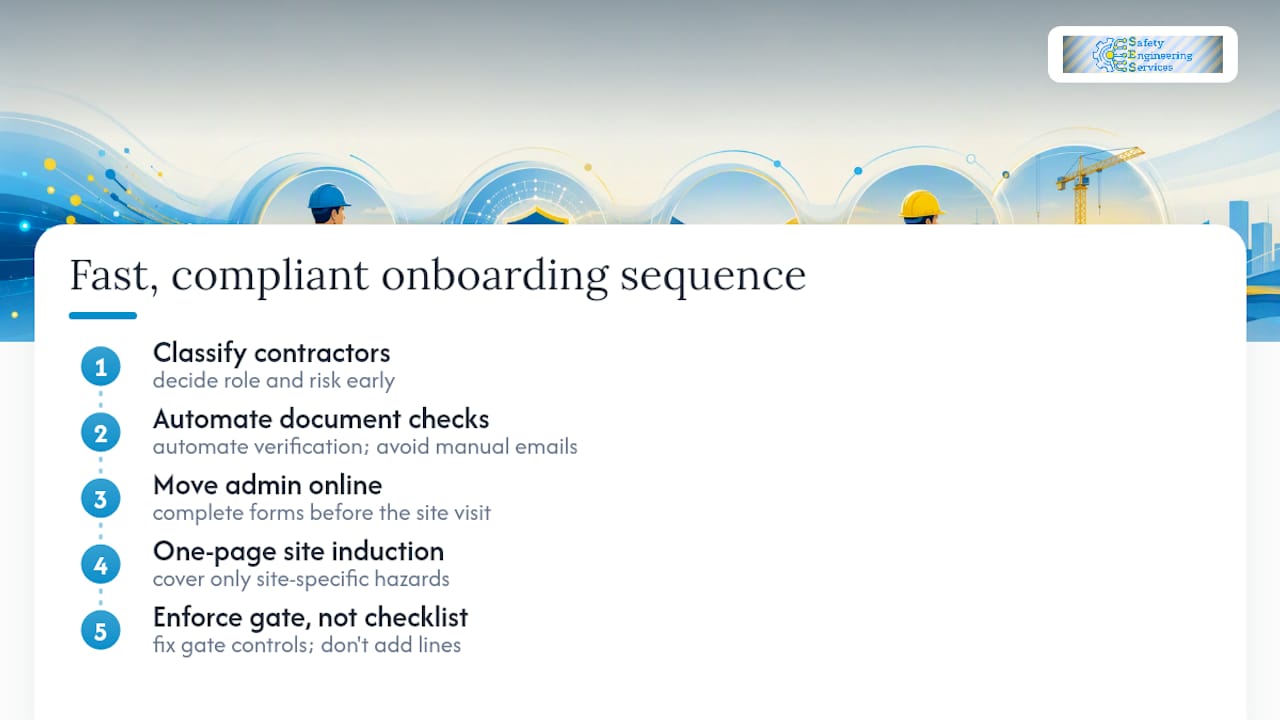
The one-page site induction is the clearest example. Recognising that a contractor's general safety training and qualifications are already verified means the site-specific document only needs to cover what's genuinely unique, the crane exclusion zone, the confined space entry point, the emergency muster location. That's not a shortcut. It's better targeting of what actually needs attention on the day.
If there's one thing worth pushing back on, it's the instinct to build a longer checklist every time something goes wrong. A missed document usually means the gate wasn't enforced, not that the checklist needed another line item.
— Safety
Sources
The workflow structure and gating logic in this article draw on published contractor onboarding checklists and workflow guides, alongside prequalification frameworks used in workplace safety compliance.
- Contractor onboarding checklist (Built to scale with you) | Worksuite
- How to onboard independent contractors efficiently: Contractor onboarding workflow guide for 2026 | Moxo
- Independent contractor onboarding checklist - Atlas HXM
For safety-specific prequalification and site induction support, see Safety-engineering's services overview or read more about the team's background.
FAQ
What are the five stages of the contractor onboarding process?
The five stages are classification, contract execution, document and prequalification verification, payment and tax setup, and access provisioning followed by kickoff. Each stage acts as a gate, and work should not begin until all five have closed.
What is the 30-60-90 onboarding rule?
The 30-60-90 rule breaks the first three months into distinct checkpoints, typically orientation and initial deliverables by day 30, independent contribution by day 60, and full integration with measurable outcomes later. For contractors, applying a lighter version, a two-week check-in followed by a 30-day review, works better than a rigid framework built for permanent staff.
What are the five C's of onboarding?
Definitions vary across HR sources, but a common version covers compliance, clarification, culture, connection, and check-back. Applied to contractors, compliance and clarification (classification, contracts, documents) matter most in the first days, while connection and check-back happen through the buddy system and two-week review.
Can a contractor reject an offer after starting onboarding?
Yes, a contractor can decline or withdraw from an engagement at any point before signing the contract, since no binding obligation exists until both parties sign. Once the contract is executed, withdrawal is governed by the termination clauses in that agreement, which is why those clauses need to be clear from the outset.