
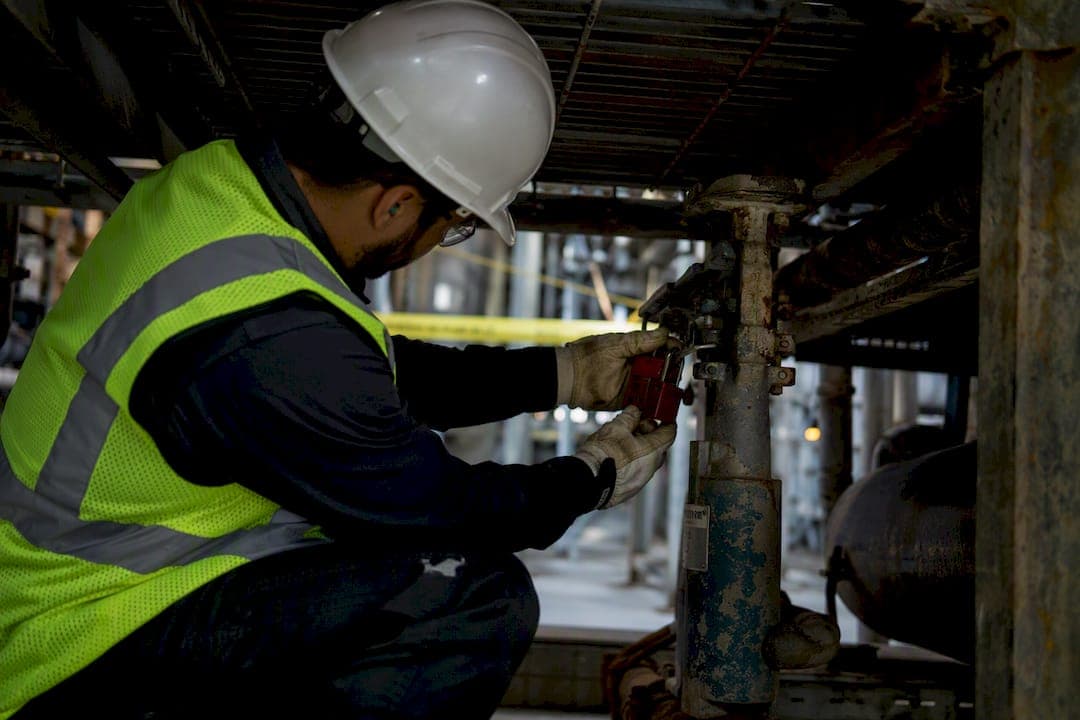
A permit to work system is a formal, recorded authorisation process that controls high-risk or non-standard work by confirming hazards are identified and controls are in place before anyone starts. Use one for hot work, confined space entry, isolation of plant (LOTO), excavation, work at height, or anywhere multiple crews might create conflicting hazards (SIMOPS). Done properly, a permit to work system delivers three things at once:
- Communication — everyone involved knows the scope, the hazards, and the controls
- Control — work cannot start, or continue, until specific conditions are verified
- Coordination — separate jobs and crews don't collide on the same site at the same time
Key Takeaways
Permit to work systems work when authorisation is tied to a genuine site check, not when the paperwork is complete.
| Point | Details |
|---|---|
| Match the permit to the risk | Use PTW for hot work, confined space, isolation, excavation, and work at height, not routine tasks. |
| Enforce face-to-face briefings | A signature without a site walk-through creates a false sense of safety, not real control. |
| Coordinate SIMOPS actively | Use a centralised permit board to catch conflicting jobs before they become incidents. |
| Pilot digital carefully | Trial one high-risk permit type before a full digital rollout, tracking close-out rates. |
| Get field-tested support | Safety-engineering builds PTW processes into machinery audits and training across NZ sites. |
Table of Contents
- Why permit to work systems matter for safety management
- Key principles of an effective permit to work
- Common permit types and when to use them
- Who does what: roles in the permit lifecycle
- How the permit to work process actually runs
- Coordinating simultaneous operations (SIMOPS)
- Should you use paper or digital permit to work systems?
- Common pitfalls in permit to work systems
- What every permit to work template needs
- How Safety Engineering Services applies PTW practice in the field
- The overlooked truth about permit to work systems
- Get field-ready permit to work support
- Sources
Why permit to work systems matter for safety management
A permit to work system is the mechanism that drags a risk assessment out of the folder and onto the actual worksite. It forces someone to check, at the point of work, that the controls written on paper still match the conditions on the ground.
That's where the value sits, and it's also where PTW systems go wrong. HSG250's guidance on permit-to-work systems makes the point that a permit is only as reliable as the checks behind the signatures. A permit issued without a genuine site inspection isn't controlling risk. It's creating a false sense of it, which is arguably more dangerous than having no permit at all, because everyone assumes someone already checked.
Traceability is the other half of the equation. When an incident happens, or an insurer or WorkSafe inspector asks questions, a well-run PTW system produces a paper (or digital) trail showing exactly who authorised what, when, and under which conditions.
Key principles of an effective permit to work
A permit to work system only earns trust if it consistently meets a few non-negotiable standards. Miss any one of these and the system becomes a formality rather than a control.
- Authorisation by a competent person — the issuer must hold the training and authority to approve that specific type of work, not just a supervisor title.
- Unambiguous scope and hazard information — the permit states exactly what work is covered, what hazards apply, and what controls are mandatory, with no room for interpretation.
- Isolation verification — for electrical or mechanical isolation, someone physically confirms de-energisation before work starts, not just ticks a box.
- Defined validity windows — every permit has a start and end time, with clear rules for suspension, extension, and formal hand-back.
- Active supervision — spot checks during the work, not just sign-off at the start and end.
Pro Tip: If your permit template doesn't force a face-to-face briefing between issuer and holder, add it. A signature on a form proves paperwork happened. A briefing proves understanding did.
Common permit types and when to use them
Different high-risk activities need different controls built into the permit itself. Here's how the major categories break down:
- Hot work permits cover welding, grinding, and cutting, and require a dedicated fire watch plus atmospheric checks where flammable vapours could be present.
- Confined space permits demand continuous gas monitoring and a rescue plan on standby before anyone enters, following the approach WorkSafe NZ sets out for confined space entry.
- Electrical isolation and lockout/tagout (LOTO) permits require a documented isolation sequence and a test-for-dead check immediately before work begins. This is distinct from a general PTW; LOTO is the physical control, while the permit is the record and authorisation wrapped around it.
- Work at height permits require scaffold or mobile elevating work platform (MEWP) inspection and clearly marked exclusion zones below the work area.
- Excavation permits need a documented underground services search and confirmation of shoring or battering before digging starts.
Who does what: roles in the permit lifecycle
Blurred accountability is one of the fastest ways a permit to work system fails. Each role needs a distinct, enforced responsibility.
- The issuer or authoriser confirms the risk assessment and site conditions justify the work, and holds explicit authority to withhold or suspend the permit if anything doesn't stack up.
- The holder or performer must follow every condition on the permit and immediately report any change in site conditions, not push through and hope.
- The supervisor carries out periodic checks while work is underway, rather than treating sign-off as a one-off event.
- Whoever manages shift handover must pass on live permit status, including anything suspended or partially complete, with a written record.
How the permit to work process actually runs
A permit to work system moves through a consistent sequence, whether it's on paper or digital. Skipping a step is usually where things go wrong.
- Request and link to risk assessment — the applicant submits a permit tied to a specific task risk assessment and method statement, not a generic template.
- Pre-start inspection and briefing — the issuer and holder walk the site together and both sign off face to face, confirming the conditions match what's written.
- Active monitoring — supervisors or the issuer carry out interim checks while the work proceeds, especially on longer jobs.
- Amend, suspend, or reissue — if conditions change (weather, adjacent work starting, a gas reading shifting), the permit gets suspended or reissued rather than quietly ignored.
- Formal close-out and hand-back — the holder confirms the work is finished, the area is safe, and plant or equipment is formally returned to service.
| Stage | What happens |
|---|---|
| Request | Permit submitted with linked risk assessment and method statement |
| Authorise | Face-to-face briefing and dual signature before work starts |
| Control | Interim checks; suspend or reissue if conditions change |
| Close | Formal hand-back confirms area is safe and plant returns to service |
Coordinating simultaneous operations (SIMOPS)
The riskiest moments on a busy site often happen when two authorised jobs meet unexpectedly. Hot work starting near a confined space entry, or excavation running alongside crane lifts, are classic SIMOPS conflicts, and each permit can look perfectly safe in isolation while creating a genuinely dangerous combination together.
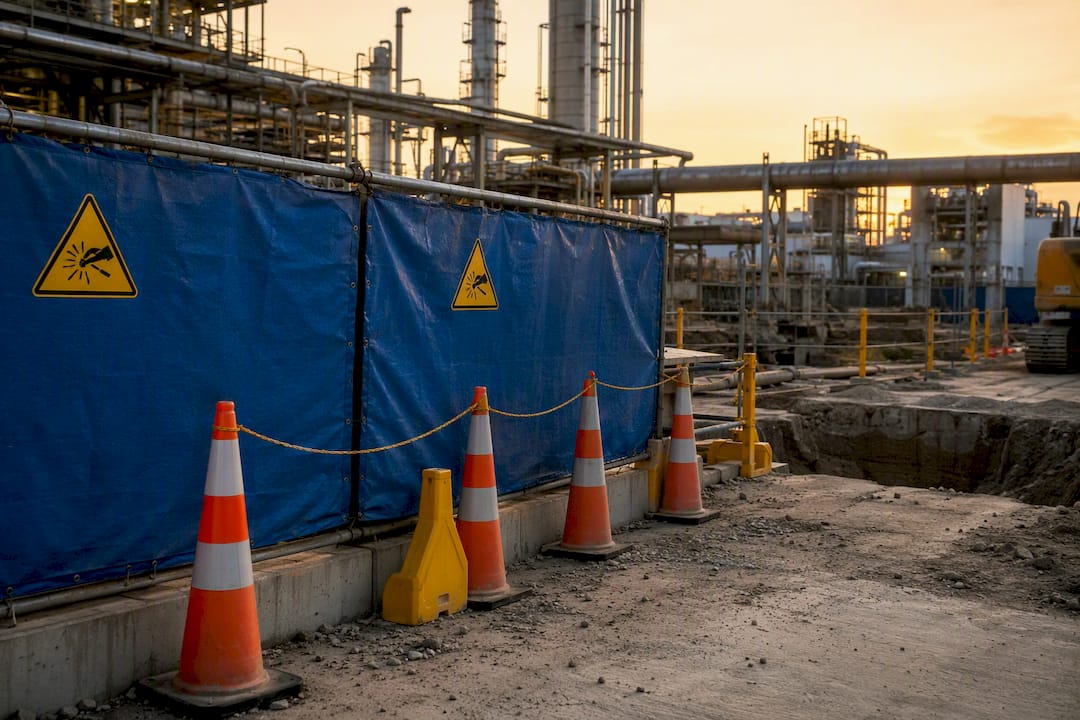
A centralised permit control board, physical or digital, is the standard fix. Auckland Airport's permit to work system is a useful real-world example: multiple teams operating across shared infrastructure need one visible reference point showing every active permit, so conflicts get caught before they become incidents. Whoever manages that board needs explicit authority to withhold or defer a permit until a conflict is resolved. Zoning, physical barriers, and cross-referencing overlapping permits round out the practical controls.
Should you use paper or digital permit to work systems?
Paper-based permit to work systems fail in predictable ways: permits get lost, close-outs get missed when a shift changes over, and nobody can see what's happening on the other side of the site.
- Digital systems enforce mandatory fields, so a permit can't be issued with a blank isolation check.
- They give live SIMOPS visibility across a whole site, not just what's on the board in front of you.
- They generate an audit trail automatically, which DNV's guidance on PTW systems treats as a core advantage over paper.
- They send automated expiry notifications, catching permits that run past their validity window, a documented benefit of digital PTW platforms.
Pro Tip: Don't flip the whole site to digital overnight. Run a hybrid pilot on one high-risk permit type first, and track close-out completion rates and time-to-authorise before rolling it out wider.
The real risk in switching isn't the software. It's clunky interface design and inadequate training turning a genuine safety tool into another box-ticking exercise.
Common pitfalls in permit to work systems
Most PTW failures trace back to a handful of repeat mistakes, all fixable with discipline rather than more paperwork.
- Treating permits as paperwork — mandate a genuine face-to-face briefing every time; a signature without a conversation proves nothing.
- Overloading the system — issuing permits for genuinely low-risk routine tasks dilutes attention and trains staff to skim rather than read.
- Poor handovers — fix this with a visible permit log or display board that shows every active and suspended permit at a glance.
- Weak competence checks — issuers and holders need role-specific training and formal authorisation, not just tenure on the job.
What every permit to work template needs
A solid permit to work template needs, at minimum: a unique permit ID, a defined validity window, and a precise location description that rules out ambiguity about where the work is happening.
Beyond that, it needs a clear description of the work itself, linked directly to the relevant risk assessment rather than duplicating it. A specific control checklist covering isolation status, monitoring requirements, PPE, and exclusion zones belongs on the face of the permit, not in a separate document nobody checks. Finally, it needs authorisation signatures from both issuer and holder, explicit suspension rules, and a close-out section that confirms the area has been verified safe before hand-back.
How Safety Engineering Services applies PTW practice in the field
Safety-engineering builds permit to work processes into machinery safety audits and maintenance projects across New Zealand industrial sites, tying isolation verification directly to the specific plant being worked on rather than a generic template. Competence checks focus on role-specific authorisation: an issuer trained on one machine class isn't automatically qualified to sign off another.
The gap between a permit that looks compliant and one that's actually protecting someone usually comes down to whether the person signing it walked the site first.
The overlooked truth about permit to work systems
Most PTW guidance obsesses over form design: fields, tick boxes, signature blocks. That's the easy part. The evidence points somewhere less comfortable: permits fail because of the conversation that doesn't happen, not the paperwork that does.
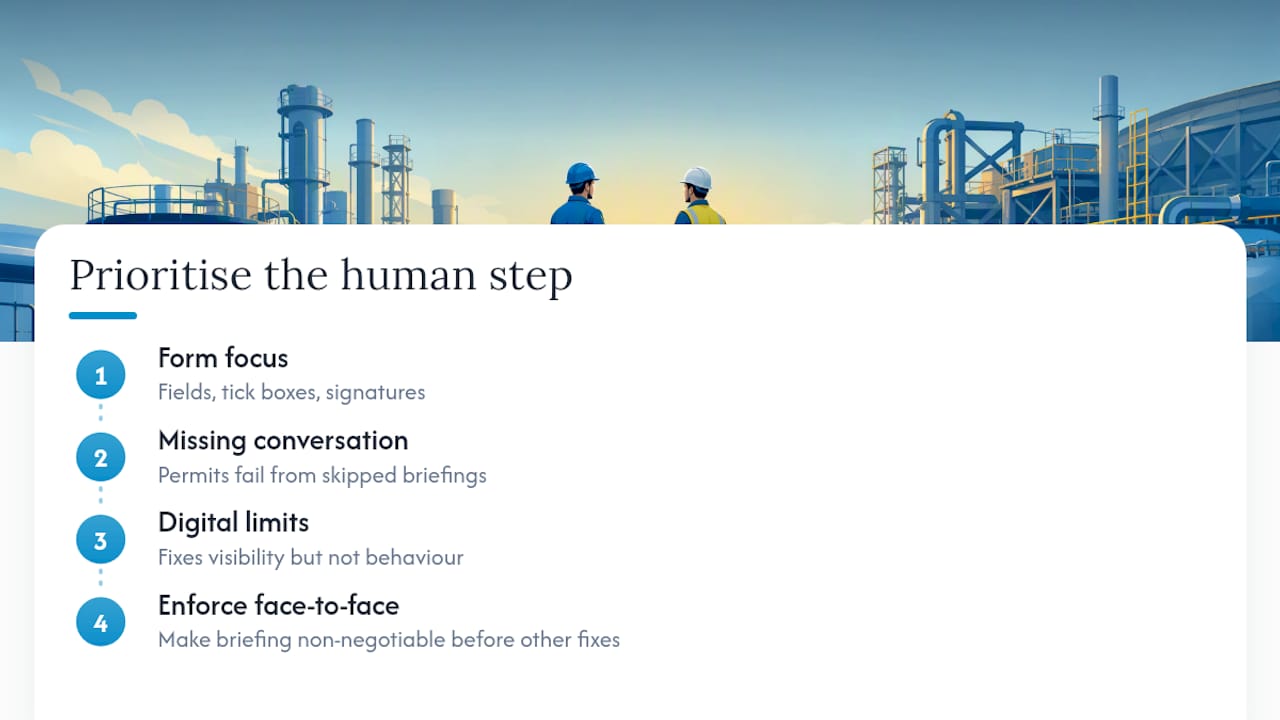
Conventional advice treats digitising a permit system as the fix for most reliability problems, and digital tools genuinely do solve real issues, like invisible SIMOPS conflicts and missed expiry dates. But a beautifully designed app still can't force someone to walk the site before they sign. If your paper system fails because issuers rubber-stamp permits without checking, a digital version of the same behaviour just fails faster and looks more official while doing it.
What should come first, before any template redesign or software purchase, is enforcing the face-to-face briefing as non-negotiable. Everything else, isolation verification, SIMOPS boards, close-out discipline, works far better once that one habit is locked in. Fix the human step first. Then worry about the form.
— Safety
Get field-ready permit to work support
Reading about permit design is one thing. Getting a system that survives contact with a real shift changeover, a confused new hire, or a SIMOPS clash on a busy site is another. Safety-engineering builds permit to work processes directly into machinery safety audits and site-specific training, rather than handing over a generic template and leaving you to work out where it breaks.

That's the practical difference for New Zealand businesses weighing up whether to build a PTW system in-house or bring in someone who's already stress-tested one against real plant and real crews. Safety-engineering's safety services cover risk assessments, isolation verification, and role-specific competence training, so your permits reflect the machinery and hazards actually on your site. If your current system relies on good intentions rather than genuine site checks, get in touch through Safety Engineering Services to talk through what a field-tested permit process would look like for your operation.
Sources
- Confined spaces: planning, entry and working safely in a confined space — WorkSafe NZ
- Guidance on permit-to-work systems — HSG250 (HSE)
- A complete guide to permit to work (PTW) systems — DNV